


Glue Ear & Otitis Media in Children
Most parents meet ear trouble the same way: a child who has had a runny nose for three days wakes at two in the morning crying and pulling at one ear. By breakfast the fever has settled a little and the child is asking for toast, and you are left wondering whether that was something serious or nothing at all. It is one of the commonest reasons children are brought to an ENT clinic, and the reassuring truth is that most of these episodes settle without anything dramatic being done.
The confusion usually starts with the words. Otitis media is simply the medical term for inflammation or infection of the middle ear — the small air-filled space that sits behind the eardrum. It is a different thing altogether from otitis externa (an infection of the outer ear canal, the part a cotton bud would reach — though cotton buds should not be going in there either; they push wax inwards and can tear the eardrum). Same ear, different address, different problem, different treatment. When a doctor says otitis media, they are talking about what is happening on the far side of the eardrum, where you cannot see and your child cannot reach.
“Otitis media means inflammation in the middle ear. Glue ear is its quiet cousin — no pain at all, just a child who suddenly seems not to be listening.”
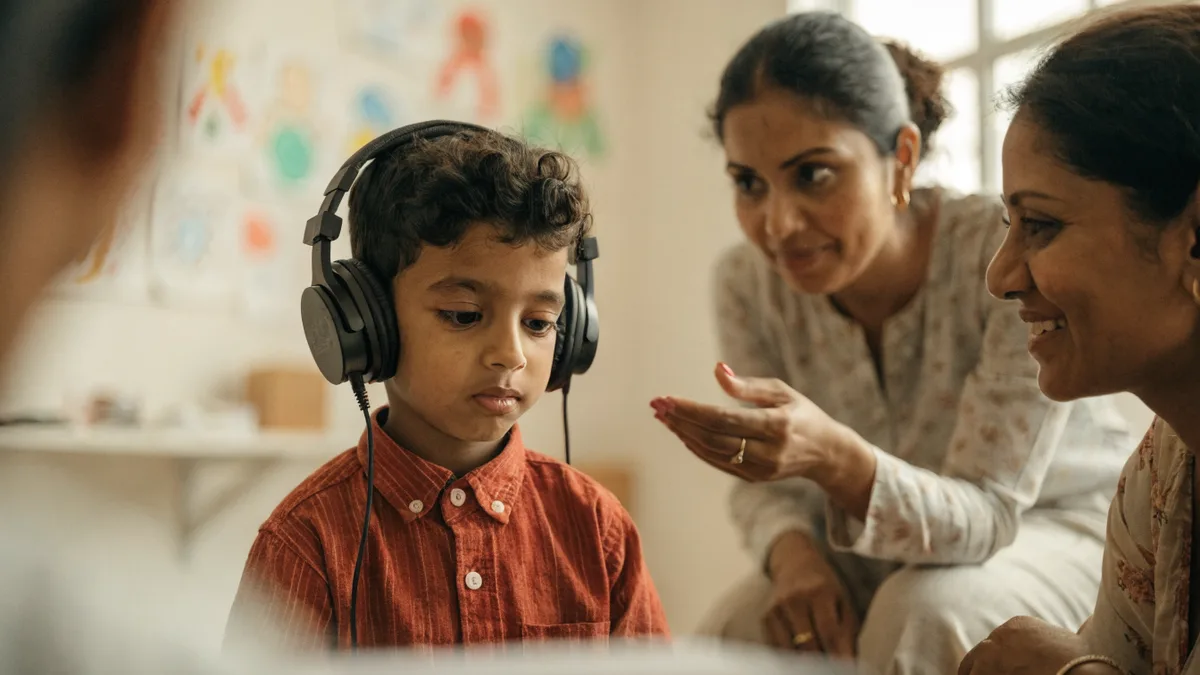
There is a second, quieter version that is much less well known. Otitis media with effusion, better known as glue ear, is fluid sitting behind an intact eardrum without any active infection. There is usually no pain, no fever and nothing to notice at bedtime. What you notice instead is the television creeping louder, and a teacher mentioning that your child seems inattentive. It is easy to read as behaviour. It is often hearing.
Why do children get ear infections so much more than adults?
The answer is a piece of anatomy called the eustachian tube (the narrow tube that links the middle ear to the back of the nose). Its job is to let air in and out so the pressure behind the eardrum matches the pressure in the room, and to let any fluid drain away down the back of the nose. When it works, you never think about it — it is what opens with a small click when you swallow on a descending flight.
In a child, that tube is shorter, softer and lies far more horizontally than it does in an adult. Gravity helps it less and it blocks far more easily. Add the things that swell the lining of the nose and the tube's opening — frequent colds, nursery or playschool where colds circulate constantly, nasal allergy, and exposure to cigarette smoke at home — and it is easy to see why the middle ear runs into trouble. Enlarged adenoids (a soft pad of tissue at the back of the nose, part of the body's defences, sitting right beside where the tube opens) can obstruct it further. Children usually grow out of this pattern as the tube lengthens and steepens with age.
Why a cold gives you a blocked, aching ear
It is the commonest way ear trouble starts, and the mechanism is worth understanding because it explains almost everything else. During a cold, the lining of the nose and of the eustachian tube swells and the tube stops venting properly. Air already in the middle ear is slowly absorbed, so the pressure behind the eardrum drops and the drum is pulled inwards. That is the blocked, full, underwater feeling, and the muffled hearing that comes with it — a blocked ear due to a cold is usually a eustachian tube that has stopped opening, not an infection at all.
If that negative pressure persists, fluid is drawn into the space, and if germs from the nose travel up the tube into that fluid, you get the painful, feverish picture of an acute middle ear infection. So earache due to a cold is not a coincidence or a piece of bad luck — it is the same illness moving one room over. It also explains why a cold that will not clear, or a nose that is blocked most of the year from allergy, deserves attention rather than resignation.
Acute otitis media: the sudden, painful one
Acute otitis media (AOM) announces itself. There is a fairly sudden earache, often at night, often with fever, and in a young child who cannot say where it hurts you may only see irritability, tugging at the ear, poor feeding and broken sleep. It typically arrives a few days into a cold. Many episodes are set off by a virus, and many that involve bacteria settle without antibiotics anyway. That is why an ear can look and feel dramatic and still be a problem that settles by itself.
Sometimes the pressure builds enough that the eardrum gives way and there is discharge from the ear. This looks alarming, but parents often notice the child settles almost immediately afterwards — because the pressure has been relieved. The perforation (the small hole in the eardrum) usually heals on its own. It should still be examined, and the ear kept dry until it has.
One firm rule: do not put anything into a painful or discharging ear — no oil, no warm oil drops, no breast milk, no herbal preparations, and no cotton buds. If the eardrum has a hole in it, anything poured in reaches the middle ear directly, and some of it can damage hearing permanently. Clean only what comes out onto the outer ear, with a soft cloth. Ear drops for a discharging ear should only be used if a doctor has looked at the eardrum first.
Otitis media with effusion (glue ear): the one with no pain at all
Otitis media with effusion means fluid sitting behind an eardrum that is intact, with no acute infection running. It very often follows a cold or an episode of AOM, as the infection clears but the fluid does not drain. It is common in young children, and in many cases the fluid clears on its own over time — though not always, which is why hearing is checked rather than assumed.
Because there is no pain and no fever, glue ear is usually spotted by its effect on hearing. The fluid stops the eardrum vibrating freely, so sound reaches the inner ear muffled — as though the child were listening through a pillow. The signs are ordinary and easy to explain away: sitting closer to the screen, mishearing and answering the wrong question, saying "what?" often, seeming to ignore you when your back is turned, being tired or withdrawn by the end of a school day, or speech that is slower to develop than you expected.
A child who has stopped listening may be a child who has stopped hearing. That is worth checking rather than correcting.
Chronic suppurative otitis media (CSOM): when discharge keeps coming back
Chronic suppurative otitis media is a long-standing middle ear infection in which there is a persistent hole in the eardrum and discharge that recurs, often over months or years, and often flaring whenever the ear gets wet or the child has a cold. Unlike the perforation after an acute attack, this one has not healed over.
CSOM is not something to manage at home with drops bought over the counter — and this is not just about delay. Some commonly sold ear drops can permanently damage hearing if they pass through a hole in the eardrum. With a perforation, drops should only ever be used on the advice of a doctor who has examined the ear. It needs a proper ENT assessment, because ongoing infection and a persistent perforation can affect hearing, and because the state of the eardrum and the middle ear is what determines the right course of action.
Long-standing discharge can also mean cholesteatoma (a pocket of skin growing where it should not, in the middle ear). It is not dangerous in itself but it slowly erodes bone, and it is the reason a persistently discharging ear should be examined rather than repeatedly treated. An ear that has been discharging for weeks needs an ENT appointment, not another course of drops. In the meantime the single most useful thing you can do is keep the ear dry — no swimming or diving, and care with water during bathing and hair washing.
Otitis media treatment: what actually helps
For acute otitis media, settling the pain comes first — simple pain relief appropriate for the child's age and weight is the mainstay in the early days. Antibiotics are not automatic. They are reserved for particular situations — very young children, severe illness, symptoms that are not settling, discharge — and that judgement is made by a doctor after actually looking at the eardrum, not from a description over the phone.
For glue ear, watchful waiting is the standard first step, because many cases resolve by themselves as the eustachian tube recovers. That waiting should be active rather than passive: treating an underlying nasal allergy or chronically blocked nose where one is present (this is worth doing for the nose in its own right — but be aware it is not a proven way of clearing the fluid), addressing adenoids if they are the obstruction, avoiding smoke exposure, and — importantly — checking hearing rather than assuming. It is worth knowing what does not help: antihistamines, decongestants and cough-and-cold syrups have all been studied in glue ear and none of them clear it, and over-the-counter decongestants are not recommended for young children at all. When fluid and hearing loss persist and start to affect speech, learning or school life, ENT options include grommets — tiny ventilation tubes placed through the eardrum under a short general anaesthetic, which let the middle ear breathe while the eustachian tube recovers, and which work themselves out naturally over about six to twelve months as the eardrum heals behind them, with sensible care about water while they are in — and adenoid surgery. Which of these applies, if any, varies from child to child and is decided after examination.
Any ear like this needs the eardrum examined directly — oto-endoscopy (looking at the eardrum with a small camera-fitted scope, shown on a screen) — with hearing assessed where that is relevant. Abhinav's ENT Care Center offers microscopic day-care surgery (surgery carried out under a microscope, going home the same day) and coblation procedures (a low-heat technique for removing tissue with less bleeding); whether either applies is decided only after assessment.
When should you see a doctor — and when should you go now?
Arrange an appointment for: earache lasting more than a day or two — though in a child under 2, don't wait the full day or two, have the ear looked at; a child whose earache or fever is no better after 2–3 days, or who is getting worse at any point rather than better, in which case re-check rather than keep waiting; repeated ear infections; any discharge from the ear; an ear that keeps feeling blocked after a cold has otherwise cleared; and — always — any concern about your child's hearing or speech, even when nothing hurts.
Some things should not wait for an appointment. Redness, swelling or tenderness of the bone behind the ear, or an ear that looks pushed forward or outward, can indicate mastoiditis (infection spreading into the bone behind the ear). This is an emergency: go to a hospital emergency department straight away, at any hour. It usually needs admission and intravenous antibiotics, and it does not wait until morning. Go to an emergency department immediately — not to a clinic appointment — if a child with an ear infection develops a stiff neck, a severe or unrelenting headache, repeated vomiting, unusual drowsiness or confusion, is difficult to wake, or has a fit. These are rare, but they are the signs that infection has spread beyond the ear and they need hospital assessment the same hour. Any fever in a baby under 3 months old needs to be assessed the same day, wherever the doctor thinks it is coming from — babies this young are assessed differently and cannot be watched at home. Severe pain, a high fever with a child who is genuinely unwell, dizziness or facial weakness should also be seen urgently.
If something about your child's ears or hearing is nagging at you, that instinct is usually worth acting on. Abhinav's ENT Care Center is an OPD (outpatient) clinic in Hastinapuram, Hyderabad — you can reach us on +91 63021 34527. This article is general information written by Dr. G Abhinav Kumar Reddy (MBBS, MS-ENT) and is not a substitute for a personal medical assessment.

Dr. G Abhinav Kumar Reddy
Consultant ENT surgeon with 13 years of experience in ear, nose and throat care — including endoscopic sinus surgery, tonsillectomy and hearing restoration. Known for careful, accurate diagnosis and treating every patient with empathy.