

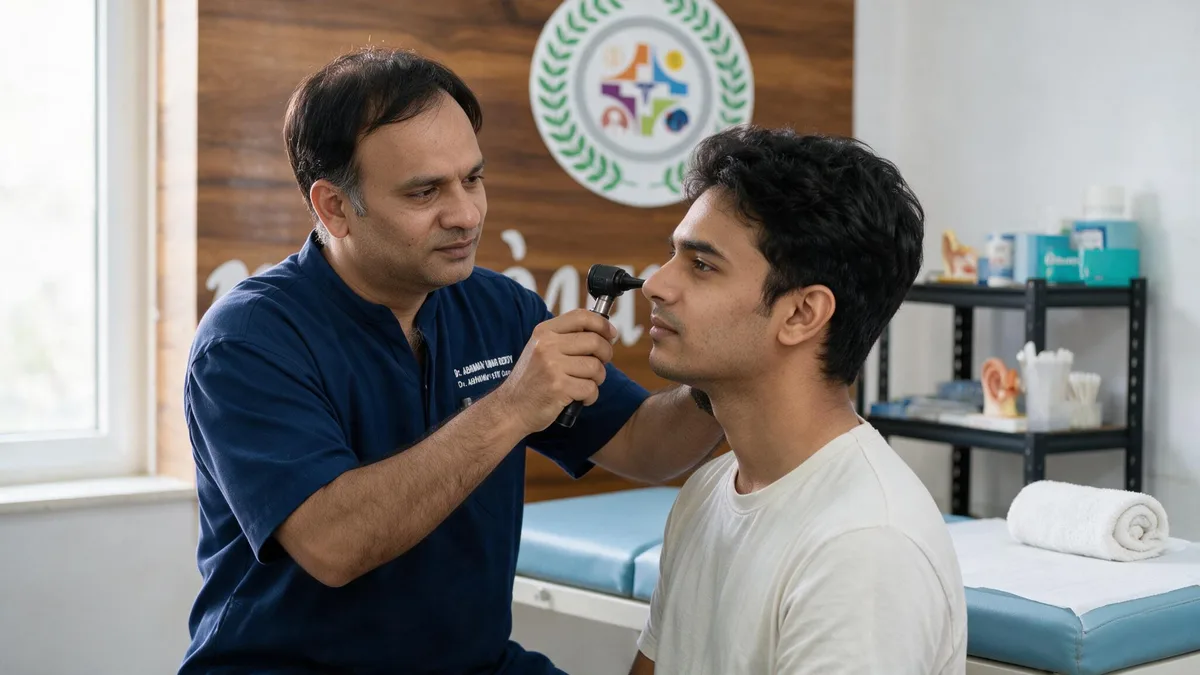
Diagnostic Ear, Nose & Throat Examination
A close, accurate look inside your ears, nose and throat, done right here in the clinic
Some ear, nose and throat problems simply cannot be seen with the naked eye. A diagnostic ENT examination lets Dr. G Abhinav Kumar Reddy look directly into each area, while you sit comfortably and awake. It uses the right scope for each part — an oto-endoscope for the ear, and a slim endoscope for the nose and throat — each fitted with a small camera that shows the view on a screen. It takes only a few minutes and involves no cuts.
What is a diagnostic ENT examination?
A diagnostic ENT examination is a direct look inside your ears, nose and throat, using instruments that magnify and light up areas a torch and mirror cannot reach clearly. It brings together three examinations, each matched to the area being checked, so the ENT specialist can see exactly what is going on. The doctor examines each area directly and explains what is seen.
The ear is examined by oto-endoscopy. A slim endoscope fitted with a small camera and light is gently placed at the opening of the ear to look at the ear canal and the eardrum, and the view is shown live on a screen — so you can see directly what is happening inside your own ear. The ear examination needs no numbing or decongestant spray, and nothing is passed through the nose or mouth. It is a simple, painless look.
The nose is examined by nasal endoscopy. A thin tube fitted with a small camera and light, called an endoscope, is gently passed into the nose. This shows the nasal passages, the tiny drainage openings of the sinuses (the air-filled spaces around the nose), the nasopharynx (the space behind the nose), and the adenoids (a patch of tissue at the back of the nose, common in children). The scope may be rigid (a straight, firm tube) or flexible (a soft, bendable one), and a decongestant and local anaesthetic spray is usually applied first to open up and numb the area so the scope passes easily.
The throat and voice box are examined by laryngoscopy (an examination of the larynx, which is the voice box). This is done with a flexible endoscope passed through the nose, or a scope or mirror through the mouth, so the doctor can see the throat and voice box working. When a flexible or rigid endoscope is used, a numbing spray is usually applied first for comfort; a quick look with a mirror often needs no spray.
It is important to understand that all of this is a diagnostic examination, not a treatment. Its purpose is to find out exactly what is causing your symptoms, so that the right care can be planned. Where a symptom such as hearing loss needs to be measured, a separate hearing test (audiometry) is arranged.
The three examinations, by area
Each part of the ear, nose and throat is checked with the instrument best suited to it. Here is how the examination is matched to each area.
Oto-endoscopy
A painless look into the ear canal and at the eardrum using an oto-endoscope — a slim, camera-fitted scope that shows the ear live on a screen, so you can see what the doctor sees. No spray is needed, and nothing is passed through the nose or mouth.
Nasal Endoscopy
A gentle look inside the nose with a slim endoscope, showing the nasal passages, the sinus drainage openings, the space behind the nose and the adenoids. A numbing and decongestant spray is usually applied first for comfort.
Laryngoscopy
A look at the throat and voice box (the larynx) with a flexible endoscope through the nose, or a scope or mirror through the mouth, so the doctor can see how the voice box looks and moves.
Why a diagnostic ENT examination is used
A direct view of the ears, nose and throat often reveals what scans and an examination from the outside can miss. Here is why it helps.
A clear, direct view
The right instrument shows the eardrum, the inner nose and the voice box in magnified detail.
Accurate diagnosis
Helps identify the likely cause of an ear problem, a blocked nose, hoarseness or throat trouble, so treatment can be better targeted.
Done in the OPD
Carried out during your outpatient visit, while you are awake, with no admission needed.
Quick and no cuts
Usually takes only a few minutes and involves no incisions or stitches.
The right tool for each area
An oto-endoscope for the ear, and a slim endoscope for the nose and throat, each matched to what needs to be seen.
Guides your treatment
Findings help decide whether medicines, further tests such as a hearing test, or a procedure are the right next step.
What the examination involves
A few simple features make this examination a comfortable, informative part of your ENT visit.
- Oto-endoscope for the ear
- The ear is examined with a slim, camera-fitted endoscope placed gently at the ear opening, showing the ear on a screen. No spray is needed.
- Slim endoscope for nose and throat
- A rigid or flexible endoscope is chosen to suit your problem and comfort when the nose or throat is examined.
- Camera, light and magnification
- The instruments magnify and light up each area, bringing the eardrum, inner nose and voice box into clear view.
- Numbing spray only when needed
- A decongestant and anaesthetic spray is used for the nose and throat examination, but is not needed for the ear.
- You stay awake
- No general anaesthesia is needed; you sit and breathe normally throughout.
- Only a few minutes
- Each examination is brief, often over in moments.
- You can see too
- Findings are explained to you during or after the examination, so you understand what was seen.
Problems it helps diagnose
A diagnostic ENT examination is used to investigate a wide range of ear, nose, sinus and throat complaints, including:
- Ear-wax build-up blocking the ear canal
- Earache or an ear infection (of the outer or middle ear)
- Ear discharge or a persistently running ear
- A blocked or full feeling in the ear, hearing loss or ringing in the ears (tinnitus)
- Checking a possibly perforated (torn) eardrum, or a suspected foreign body in the ear
- Fluid behind the eardrum (glue ear), common in children
- A persistently blocked or stuffy nose
- Chronic or recurring sinusitis (long-standing sinus inflammation)
- Nasal polyps (soft swellings inside the nose)
- Enlarged adenoids, especially in children who snore or mouth-breathe
- Recurrent nosebleeds, to find the bleeding point
- Hoarseness or a change in voice that does not settle
- Ongoing throat discomfort, a lump-in-throat feeling or persistent cough
- Difficulty or discomfort while swallowing
What to expect
Consultation
Dr. Abhinav listens to your symptoms, examines you and explains which parts, ear, nose or throat, need a closer look.
Preparation
The ear examination needs no preparation. If your nose or throat is to be examined, a decongestant and numbing spray is applied there and given a short while to act.
The examination
The ear is checked with an oto-endoscope, and the nose or throat with a gently passed endoscope, while you sit and breathe normally. It usually takes only a few minutes.
Discussing findings
The doctor talks you through what was seen, and answers your questions.
Next steps
Together you plan the way forward, whether medicines, a hearing test, further tests or a procedure.
After your examination
Because no cuts are made and no general anaesthesia is used, most people return to their normal day right away. The ear examination needs essentially no aftercare, there is nothing to recover from, and you can carry on as usual.
If your nose or throat was examined, you can usually go back to work or school straight away, and eat and drink once the numbing spray has fully worn off, so you do not accidentally bite or choke. Some people notice mild, short-lived effects such as slight sneezing, a little watering of the eyes, a mild sore throat or, rarely, a small streak of blood from the nose. These usually settle on their own quickly. If anything worries you, contact the clinic.
The ear examination needs no aftercare
After the ear examination there is nothing to wait for; you can eat, drink and carry on straight away.
Wait before eating after nose or throat
If your throat was numbed, hold off on food and hot drinks until the numbness has fully worn off.
Be gentle with your nose
After a nasal examination, avoid hard nose-blowing for a short while, especially if you were investigated for nosebleeds.
Mild effects settle fast
Slight sneezing, watering eyes or a mild sore throat after a nose or throat examination usually pass on their own.
Call if concerned
Reach the clinic on +91 63021 34527 if bleeding, pain or any symptom feels unusual.
See clearly what is causing your symptoms
If an ear problem, a blocked nose, hoarseness or ongoing throat trouble is bothering you, a diagnostic ear, nose and throat examination at Abhinav’s ENT Care Center can help find the cause. Call +91 63021 34527 to book a consultation with Dr. G Abhinav Kumar Reddy in Hastinapuram, Hyderabad.
Book an appointment
Get an accurate diagnosis and a treatment plan tailored to you.
Meet Your ENT Specialist
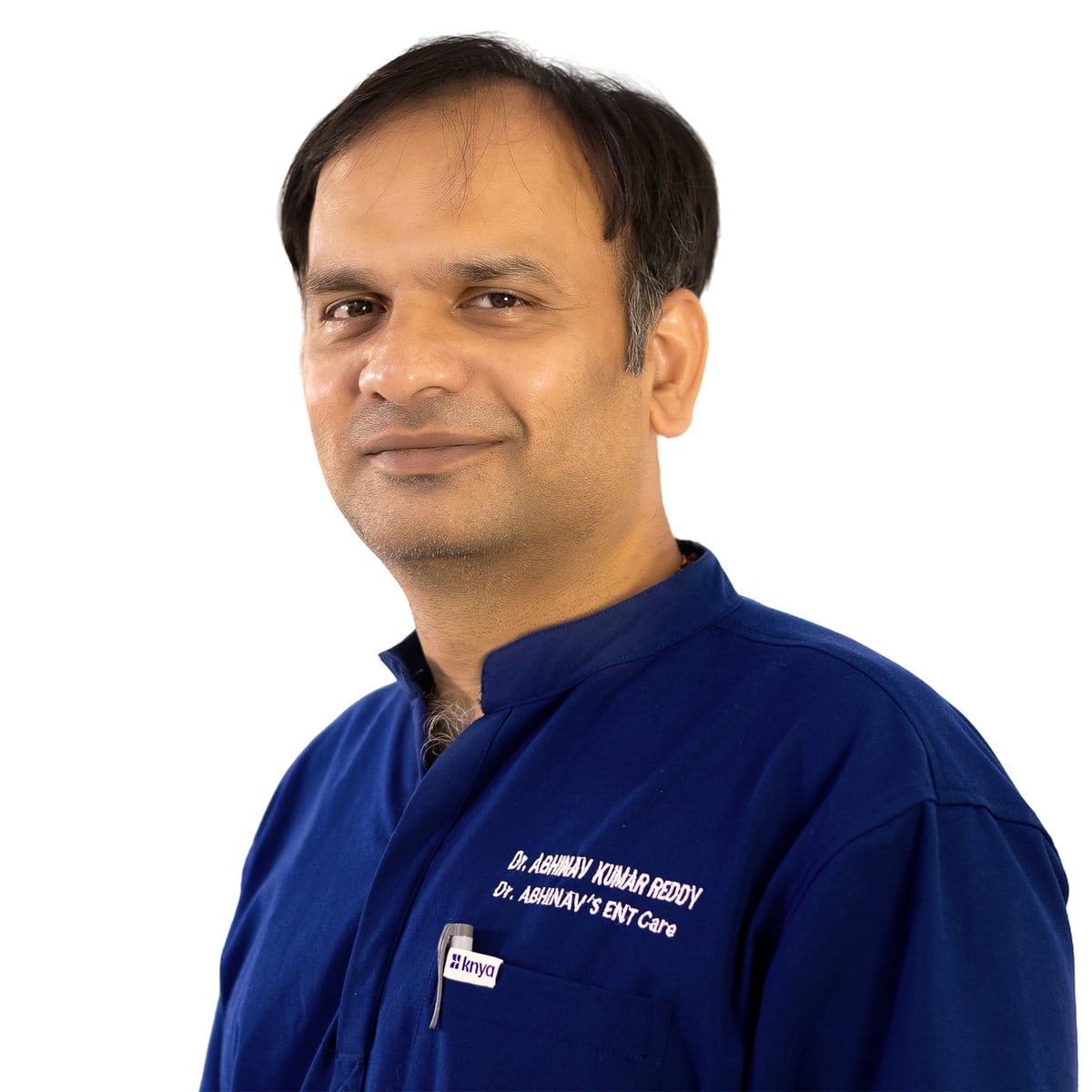
Dr. G Abhinav Kumar Reddy
MBBS, MS (ENT) — ENT Specialist