
Nosebleeds: Causes and How to Stop One
A nosebleed has a way of feeling far more dramatic than it is. Blood appears without warning, it looks like a lot on a tissue or a shirt, and the person it is happening to is usually the least calm person in the room. The reassuring truth is that epistaxis (the medical word for a nosebleed) is extremely common and only rarely serious. Most nosebleeds you will ever have will stop at home, with nothing more than your own fingers and a little patience — provided you do the right thing in the first ten minutes.
The reason they happen so easily is simple anatomy. The lining inside your nose is thin, richly supplied with blood, and sits very close to the surface — its job is to warm and moisten every breath you take, and that job needs a generous blood supply. The large majority of nosebleeds start from a small patch on the septum (the partition between the two nostrils) just inside the nose, called Little's area or Kiesselbach's plexus, where several small vessels meet. It is a fragile spot, and it is within easy reach of a fingernail, a dry winter draught or a forceful blow of the nose.
“Most nosebleeds come from fragile vessels just inside the nostril — sit up, lean forward, and pinch the soft part for a full ten to fifteen minutes without letting go.”
Bleeds from this front patch are called anterior nosebleeds. They usually affect one nostril, come out of the front of the nose, and respond well to correct first aid. Less commonly — more often in older adults — bleeding starts further back in the nose. These posterior nosebleeds tend to be heavier, may run down the back of the throat as much as out of the nostril, and generally need medical help rather than home measures. So the first thing worth knowing is why nosebleeds start — and the second is exactly what to do in the ten minutes after one does.
What causes a nosebleed?
Most of the time, the cause is something mechanical or environmental rather than sinister. Nose-picking is far and away the most common cause, especially in children. Forceful nose-blowing does the same thing from the inside. Dry air — a heated room, a long spell in air conditioning, a dry season — dries the lining until it cracks and the vessels underneath give way. Colds, sinus infections and allergic rhinitis (allergy affecting the nose lining) leave that lining inflamed, swollen and much more likely to bleed when you sneeze or blow.
Other common causes include a knock or minor injury to the nose, a deviated septum (a bent partition) that funnels dry airflow over one side and crusts it, and — in small children — a foreign body (a bead, seed or bit of toy) pushed into a nostril, which typically causes bleeding with a smelly, one-sided discharge. A suspected foreign body needs removing by a doctor: please do not try to fish it out at home, as this usually pushes it further back and makes the bleeding worse. If there is any chance a child has put a button or disc battery in the nose, treat it as an emergency and go straight to hospital — batteries can burn through the septum within hours.
Blood-thinning medicines such as aspirin or warfarin do not create the bleeding point, but they make any bleed last longer and look worse. High blood pressure is best thought of as a contributor rather than a direct cause: it makes a bleed harder to settle rather than starting it. Rarely, repeated bleeding points to a bleeding or clotting disorder, or to a growth inside the nose. That is why one rule is worth remembering above all the others: recurrent bleeding always from the same side, particularly with blockage on that side, deserves an examination in an adult. It is usually something ordinary — but it should be looked at rather than assumed.
How to stop a nosebleed: step-by-step first aid
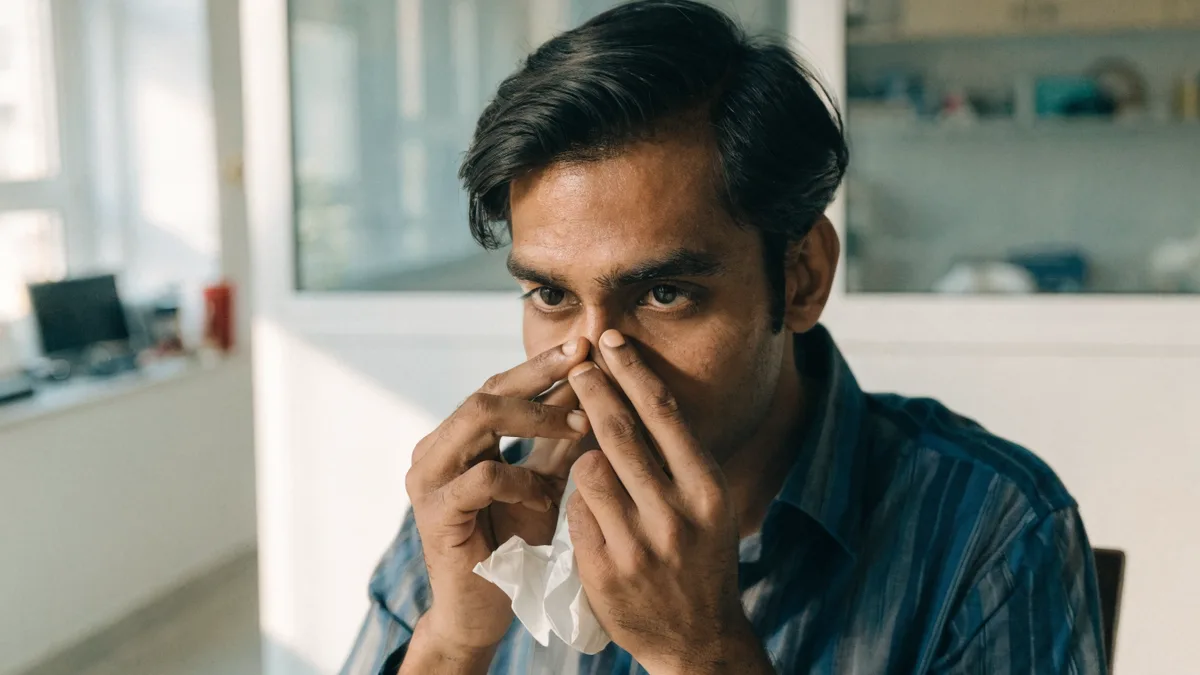
This is the part worth memorising, because doing it properly stops the great majority of nosebleeds. Sit up, with your head above your heart. Lean forward, so blood runs out of the front of your nose rather than backwards. Using your thumb and index finger, pinch the soft part of your nose — the fleshy bit just above your nostrils, not the hard bony bridge higher up. Squeeze firmly. It should feel like a proper pinch, not a gentle hold. Breathe through your mouth.
Now hold it for ten to fifteen minutes without letting go. Not two minutes with a peek, not a release every thirty seconds to see how it is going. Every time you let go to check, you break the clot that was forming and start the clock again. Set a timer if you can — ten minutes is much longer than it feels when you are watching a tissue. An ice pack or cold cloth on the bridge of the nose or the back of the neck may help a little. Spit blood out rather than swallowing it; swallowed blood irritates the stomach and often comes back up. If it is still bleeding when you let go, pinch again the same way for another ten to fifteen minutes. If it has still not stopped after that second attempt — around twenty to thirty minutes of pressure in total — stop trying at home and get medical help.
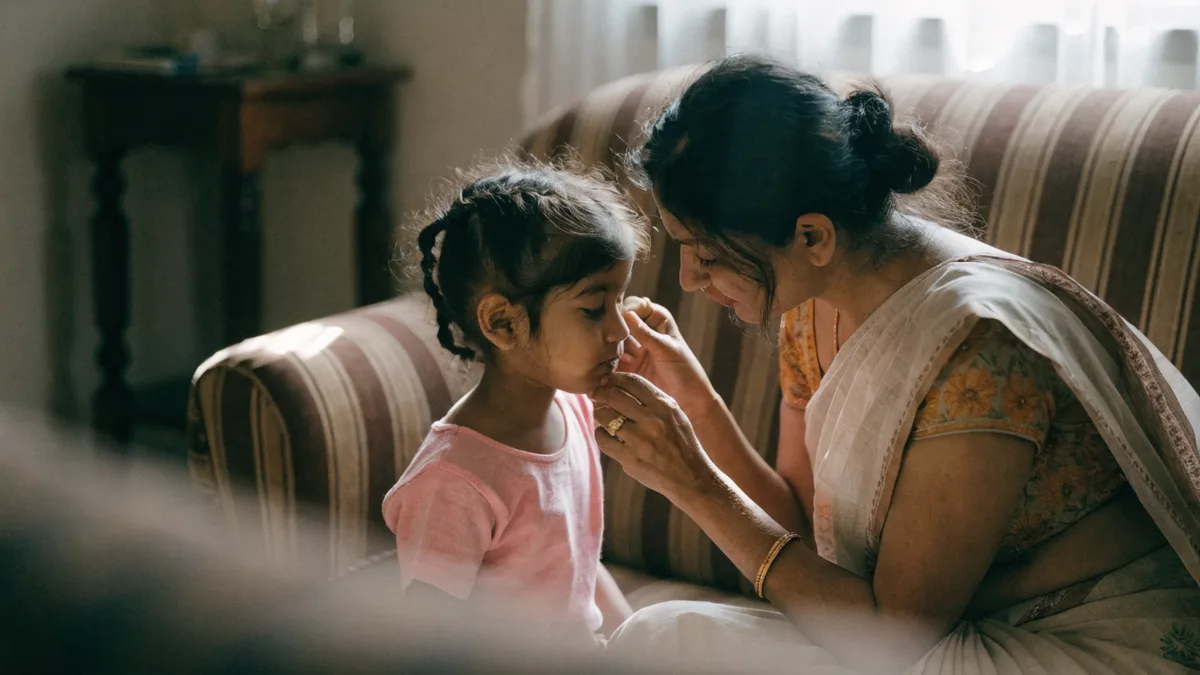
With a child, do the pinching for them. Sit them upright on your lap leaning slightly forward, pinch the soft part of their nose yourself, and hold it — a child will not hold it long enough on their own, and children are the group these front-patch bleeds happen to most. Distraction (a screen, a story, a song) is what buys you the full ten minutes. It feels unkind to hold on while they wriggle, but letting go every few seconds is what keeps a bleed going.
Why you should never tilt your head back
Almost everyone was taught to tip the head back and hold a nosebleed until it stops. It is still repeated confidently in homes, offices and playgrounds — and it is wrong. Tilting back does not stop the bleeding; it simply hides it. The blood drains down the back of your throat instead of out of your nostril, so you lose sight of how much is coming and you swallow it. Swallowed blood commonly causes nausea and vomiting, which is distressing and, worse, the retching can restart the bleed you had just settled. Lean forward instead: you want to see what is happening.
Stuffing tissue or cotton wool up the nostril is not a substitute for pinching either. It tends to sit above the bleeding point without compressing it, and pulling it out later can tear the fresh clot straight off. (Packing done in a clinic is a different thing altogether — placed under vision, against the bleeding point.) By all means hold a folded tissue under your nose to catch the drips; just do the pinching as well. Direct, sustained pressure on the soft part of the nose is what actually works. Lean forward, pinch, wait.
When a nosebleed needs urgent medical help
Some nosebleeds are not for home management. Go to the nearest emergency department (casualty) — or call for an ambulance if the person is faint, drowsy, or the bleeding is torrential — if the bleeding has not stopped after twenty to thirty minutes of correct, uninterrupted pressure; if it is very heavy, or you are gulping or vomiting blood; if it started after a significant blow to the head or face, especially if the nose looks deformed or if clear, watery fluid is coming from the nose along with the blood; or if you feel faint, dizzy, weak or short of breath. A nosebleed in a child under two should always be assessed. And if you take blood thinners and a bleed will not settle, do not sit it out at home — be seen.
Bleeding that keeps restarting despite good first aid may be coming from further back, where pressure at the nostril cannot reach. That is not a reason to panic — it simply needs a doctor to control it. One practical point: Abhinav's ENT Care Center is an OPD (outpatient) clinic and is not the place for an active, heavy bleed. If blood is pouring and will not settle, go to a hospital with emergency facilities first. The nose can be examined properly afterwards, once things have calmed down.
When to see an ENT specialist about recurrent nosebleeds
Book an appointment if nosebleeds keep coming back, if they are always from the same side, if one side of your nose is also blocked, or if you notice easy bruising or bleeding elsewhere — from the gums, or cuts that take a long time to stop. Frequent nosebleeds in a child who is otherwise well are usually from a dry, crusted front patch, but they are still worth showing to someone.
In the clinic, the first step is looking properly. Diagnostic nasal endoscopy — passing a thin telescope into the nose after numbing it — lets the ENT specialist see the lining, the septum and, often, the actual bleeding point, which is not visible from outside. If a single fragile vessel is responsible, sealing that vessel (cautery) is one treatment an ENT may consider. Whether it is appropriate, and what else may be needed, is decided after examining you — it varies from person to person.
How to prevent nosebleeds
Start with the twenty-four hours after a bleed, because that is when a fresh clot is easiest to dislodge. Avoid blowing or picking the nose, avoid bending down or heavy lifting, avoid very hot drinks and hot baths, and go easy on strenuous activity. If a small crust forms, leave it alone — it is doing a job.
Longer term, prevention is mostly about keeping the lining moist and leaving it alone. Humidify dry air where you can, particularly in a heated or air-conditioned bedroom at night. Plain saline drops or spray — not a medicated or decongestant spray, which is a different thing, and regular use of decongestant sprays causes problems of its own — help keep the lining from drying and cracking. It is a simple, low-risk measure, though it will not settle every case. If allergy is part of the picture, treating the allergy calms the inflamed lining that keeps bleeding; that is a conversation to have at your appointment rather than something to self-prescribe.
Break the picking habit if you can, and keep children's fingernails short so that the inevitable exploring does less damage. Blow your nose gently, one side at a time. And if you are on blood thinners, do not stop or change them on your own because of a nosebleed — speak to the doctor who prescribed them.
Speak to an ENT in Hastinapuram, Hyderabad
If nosebleeds are becoming a pattern, or one side of your nose bleeds and blocks, Dr. G Abhinav Kumar Reddy (MBBS, MS-ENT) sees patients at Abhinav's ENT Care Center, an OPD (outpatient) clinic in Hastinapuram, Hyderabad. Diagnostic nasal endoscopy is available in clinic, and the appropriate next step is decided after examining you. To book, call +91 63021 34527.
This article is general information about epistaxis and is not a substitute for a personal medical assessment. If a nosebleed is worrying you, please have it looked at — and if it is heavy or will not stop, go to an emergency department rather than waiting for an appointment.

Dr. G Abhinav Kumar Reddy
Consultant ENT surgeon with 13 years of experience in ear, nose and throat care — including endoscopic sinus surgery, tonsillectomy and hearing restoration. Known for careful, accurate diagnosis and treating every patient with empathy.